
Today, at the request of the BCC Community, we're going to talk about training and injury prevention with Manu da Silva Évora.
Disclaimer: This is not medical advice, it's entertainment.
A reality check
Winter is coming, we feel healthy and we're training, or maybe not so much. We're thinking about all the missions we want to do, and we probably take it for granted that our body won't be a limitation. If that's the case, we're in for another season for the books. But the reality is that many people will run into aches, pain and eventually injuries. Some already existing, others new. The good news is that from a training perspective, we can try to prevent and manage certain types of injuries.
A small ache
Sometimes the body warns us, and the problem is knowing what to do when an ache shows up. Maybe the best move is to prevent a more complicated situation in the first place. But what injury are we preventing? How can we prevent it? Can we prevent it at all? Before going further, we need to know that we're stepping into complex terrain, and what that implies.
“As complexity rises, precise statements lose meaning and meaningful statements lose precision” – Lofti Zadeh

The goal is to look for meaningful answers and statements. For now, we're not interested in describing a perfect model that accounts for every variable in a world as complex as injuries. That's why we won't be talking about popular concepts like nutrition, rest, stress, flexibility, muscle balance, technique. There's no doubt they can give us better context for injury prevention. It would be interesting to keep gaining precision on these concepts in this blog, but remember that we risk losing meaning. So let's look for a good-enough model that lets us bring practical applications to our activity in the mountains.
Where do we start?
We can begin by stating that training can prevent a large number of injuries. It's a meaningful statement that lacks precision, but it's probably enough for a lot of people. As a coach, I sometimes need to take the risk of seeking more precision. From a training perspective, we'll talk later about some important principles: tissue tolerance, work capacity, consistency, specificity and progression.
The necessary context
First, we need to classify and understand which injuries we, as athletes and mountain enthusiasts, are most likely to be able to prevent and/or manage. Let's classify injuries by their causes:
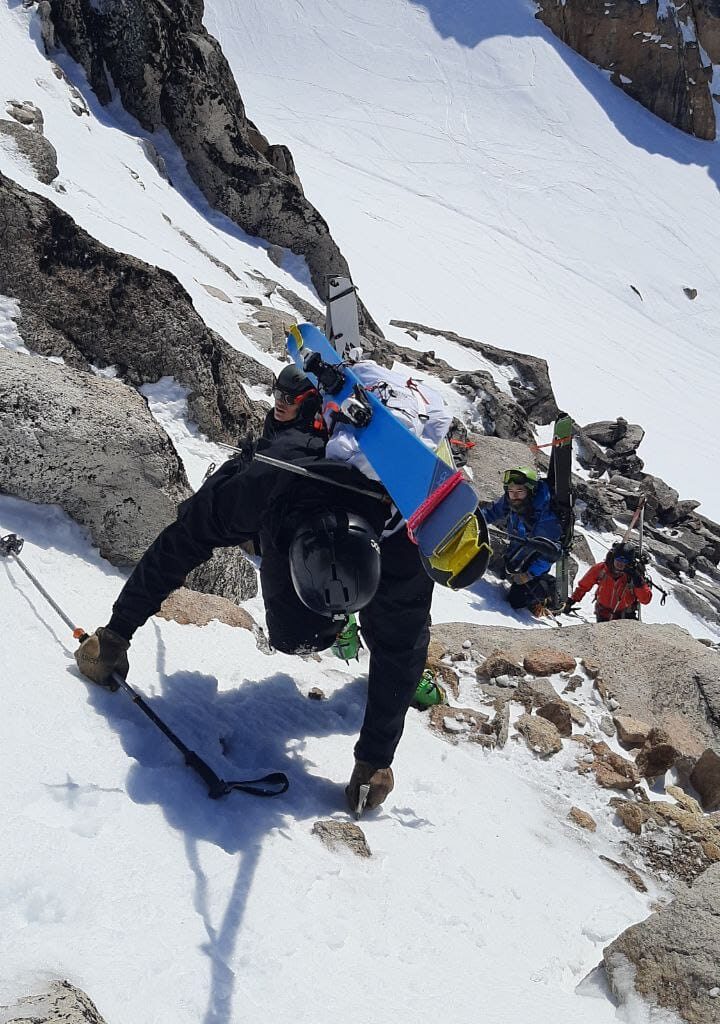
- Trauma injuries: Unexpected events like a ski binding releasing while skiing a couloir at high speed, or a bad fall off a rock. We can hardly control the variables (environment, equipment, objective hazards, etc.) involved in this kind of injury, since it's the most complex context of all. The cause of this type of injury is limited to imprecise but meaningful answers: “I shouldn't have picked up so much speed in that part of the couloir,” “We should have read the terrain better.” From a training perspective we're limited; maybe all we can say is that “we should train strength so we're strong enough to take any hit.” Is that a precise statement? No, but we'll settle for its meaning and take it as good enough.
- Overuse injuries: The specificity of our sports exposes us to the same movement patterns over and over again. Certain structures or tissues will be compromised by overuse. We're still in a complex context, but a friendlier one, possibly because these injuries develop over time. We can make the effort to control some variables and make more precise statements. For example: “My patellar tendon hurts because I've been skiing moguls every day, more than I'm used to.” With this precision we have valuable information to make decisions about our current condition.
Both types of injuries are common in our community, but since this is a training blog, we'll focus on overuse injuries, where there's room to gain more precision. These injuries directly compromise our ability to do the activity we love, affect us physically and emotionally, and stay with us for a significant period of time.
Core principles
When we head out to the mountains, we're not necessarily thinking about training; we do it for pleasure. But from training theory, we can use some important principles to keep in mind on our outings from a physical and injury-prevention standpoint:
- Tissue tolerance: The ability of tissues to withstand stress and recover without suffering damage that leads to injury. This covers all tissues: bones, tendons, ligaments, cartilage, fascia, nerves, muscles, skin, etc.
- Work capacity: The amount and magnitude of a given activity that a person can perform and recover from in order to adapt and improve their overall fitness level.
- Consistency: To produce adaptations, a certain frequency of stimuli over time is required.
- Specificity: Stimuli must be properly planned for the structures and tissues we want to adapt.
- Progression: Gradually increasing stimuli to seek new adaptations.
Pancho's case.
Pancho is just on his second outing of the season. He's just arrived at the hut after skiing in great conditions. Although his knee had been bothering him since the day before, while walking from the car to the hut, he decided to do all the descents he had planned for the day. He took off his boots, and while he put water on to heat for some mate, a few thoughts flew through his head: “Years don't come alone,” “My knee can't handle this much,” “I have to start training.” After drinking the mate, his body had cooled down and his knee hurt even more. He grabs a small glass of water and pops a pill. Pancho will probably keep skiing all season, along with his ache.
It's already October, the boots have pretty much been hung up, and Pancho commits to improving his current condition. He goes to the gym on a Monday, does some mobility drills he saw on TikTok, warms up his core and grabs the Olympic barbell. He loads some plates on the bar and does 3 sets of 8 reps with 60 kg. He finishes his session on the treadmill, goes home and feels great after a shower. The days go by, and in the next session when he has to squat, his knee feels sore and very reactive. The solution? He decides to stop doing squats or any movement that causes discomfort, thinking the ache will eventually go away now that he's not skiing.
A good-enough model
We could analyze Pancho's case based on the core principles of our model, to arrive at precise and meaningful statements that tell us where we stand.
- Tissue tolerance: Initially, his tendon is unadapted and unable to withstand the stress of that particular tour.
- Work capacity: His season turns into a roller coaster of symptoms because he fails to recognize his current work capacity. He always overdoes it, by a lot or by a little. His body can't recover from those stress levels at the moment.
- Consistency: The stimuli his body regularly receives aren't appropriate for his current condition.
- Specificity: Specificity requires him to reduce and/or adapt the stimulus of the sport itself, and focus on the stimuli specific to his rehabilitation.
- Progression: There's no intention to build progression up from lower levels of activity.
Pancho's activity over the coming months will probably behave similarly to the
following graph.

- Episodes of intolerable pain occur at ever lower levels of activity.
- Rest periods usually feel good, but when he resumes activity, the ache comes back.
- Activity declines over time, becoming less tolerable and more reactive.
Plot twist
After a few trekking trips at the start of summer, Pancho still feels a lot of discomfort in his knee, specifically on the descent. Finally, he decides to visit the orthopedist and get the necessary tests to get a diagnosis: Patellar tendinopathy. The doctor refers him to physical therapy, where he learns to manage his current injury. Pancho's next few months look like the following graph.

- He doesn't reach episodes of intolerable pain; activity is adjusted according to how he feels, and symptoms will vary.
- Activity increases over time. The specificity of the stimuli begins to bear fruit thanks to consistency and progression.
The crux
This story probably sounds familiar; the cycle seems to be the same with a great many injuries. An ache appears, it persists during activity, and we don't know how or don't want to manage it. We're at the crux of the situation. If we keep the throttle down, we'll probably see it evolve into an injury. At that point, a visit to a doctor's office is unavoidable.
An alternate route
So, do we make the effort to find another possible route ahead of time and avoid the crux?
First, Pancho should have started his season in better physical condition, with greater work capacity and better tissue tolerance. We should train to prepare our bodies for greater demands than the sport we do. This process takes time. This is where a pre-season can make the difference, especially if you work on your weaknesses. Strength training is perhaps the most important tool for preventing any type of injury.
Second, had he thought about the principles we've laid out, Pancho wouldn't have gone from zero to a hundred. Managing the loads in an activity could put us in a better position when it comes to potential injuries, since we give our body a better chance to recover properly and allow the necessary adaptations.
The moral of the story
Injury prevention should be the priority in our community when it comes to training, especially overuse injuries. Through training, we can try to control certain variables and use them in our favor. Is it a perfect model? No, but it can be good enough.
See you next time!
Manu-