


As we mentioned in previous posts, when it comes to this activity we need to be prepared, plan ahead, and leave no loose ends so that our descents are pure enjoyment. This time, we're going to talk about the universe of snow. We could talk about this topic for hours; in fact, there are plenty of books devoted to this magical world of the snowpack, from its formation in the sky as a crystal to its arrival on the ground as one more grain of snow under our boards. From there come its many transformations, depending on factors like temperature, wind, snowpack depth, and energy exchange between the ground and the air. There are a lot of factors, and understanding these concepts takes time and specific training. Today we're going to talk about a fundamental part of snow that matters to us: avalanches, starting with the basic concepts.
We divide avalanches into two major groups: slab avalanches and loose snow avalanches. There are other classifications, and in general people talk about nine avalanche problems: wind slabs, storm slabs, wet slabs, persistent slabs and deep persistent slabs, wet and dry loose snow avalanches, glide avalanches, and cornice falls. But for now we're going to study how slab avalanches happen, since they cause more than 80 percent of the accidents in our mountains.
To understand this, we need to keep these four ingredients in mind:
- avalanche terrain
- a slab
- critical balance
- a trigger
Terrain: We need a slope angle between 30 and 45 degrees. According to several studies, the most frequent angle is between 37 and 38 degrees. In general terms, this terrain should have no anchors, or only very sparse ones. To make it even easier, imagine that these average slope angles correspond to the red and black runs at a ski resort.
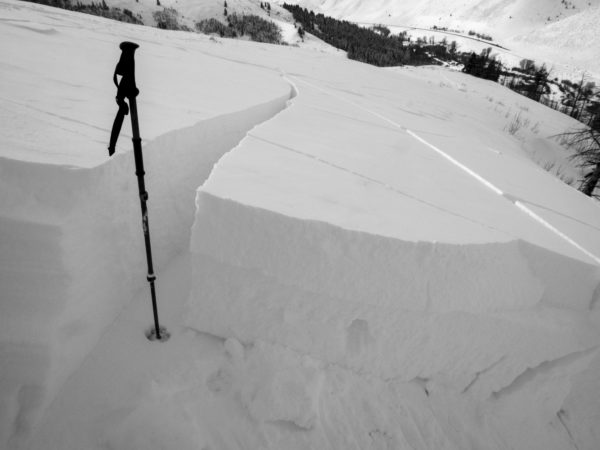
Components of a slab avalanche:
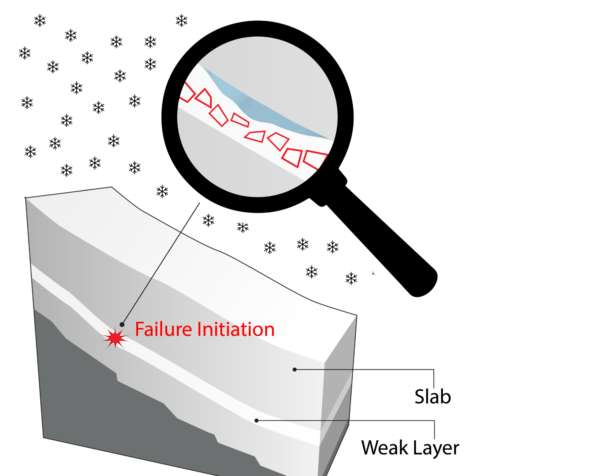
Slab: Snow that is relatively harder or more cohesive than the snow around it.
Weak layer: Snow that is relatively weaker or less cohesive, creating instability and, in some cases, causing the slab to slide.
Bed surface: The surface the slab slides on.
Now imagine all of this as a sandwich. The bread is the bed surface, the mayonnaise is the weak layer, and the cold cuts are the slab. If everything is in balance, nothing happens. But if we add slope angle and something that upsets that balance, we can see how the harder layer (the cold cuts) sitting on top of something softer can slide, and there's our slab avalanche. We need to start thinking of the snowpack as a structure of many stories, each with different hardness and strength depending on snowfall intensity, temperatures, weight, and so on. Between these layers there are weak layers that we, as skiers, can end up affecting.
The snowpack builds up through the season as these layers or stories. They can form on surfaces created by the sun, which makes melt layers (sun crusts); by wind, which compacts the snow and creates dense wind crusts; or, on clear nights, by surface hoar. So when compacted or cohesive snow sits on top of weak or poorly bonded snow, we are looking at a slab.
What is a weak layer?
Imagine putting one pane of glass on top of another and tilting it: nothing happens, no matter the angle. Now what happens if we add water in between? It will surely slip and fall. That's what a weak layer is all about.
Sometimes the fracture that forms can be triggered by a skier passing through, or by added weight, for example more new snow on top or a change to warmer temperatures that makes the slab above heavier and pulls it down under the force of gravity. The snow that sometimes forms a weak layer can be faceted snow (angular and large-grained), surface hoar, new snow with little structure, or a weak interface, for example new snow on top of ice, and so on.
What is a bed surface?
The name pretty much says it, but think of these situations: rain crusts, sun crusts, hard old snow, wind-hardened snow, melt-freeze crusts. Any harder surface that a slab slides on.
What is critical balance?
This is the relationship between mass (the amount of snow), gravity (the pull that mass of snow has to slide downhill), and slope angle. We need to understand that this balance can be changed by anchors in the terrain or by different terrain shapes, such as convex features that create more tension in the snowpack, as well as by the friction the slab has on the weak layer or the cohesion within the slab itself, since slabs can be soft or hard.
What are the triggers?
We can split them into two groups:
Human: skiers, splitboarders, trekkers, climbers, snowmobiles.
Natural: snowfall, wind, sun, warming temperatures, cornice fall.
With all the ingredients of our sandwich clear, we know when we may be dealing with a slab avalanche.
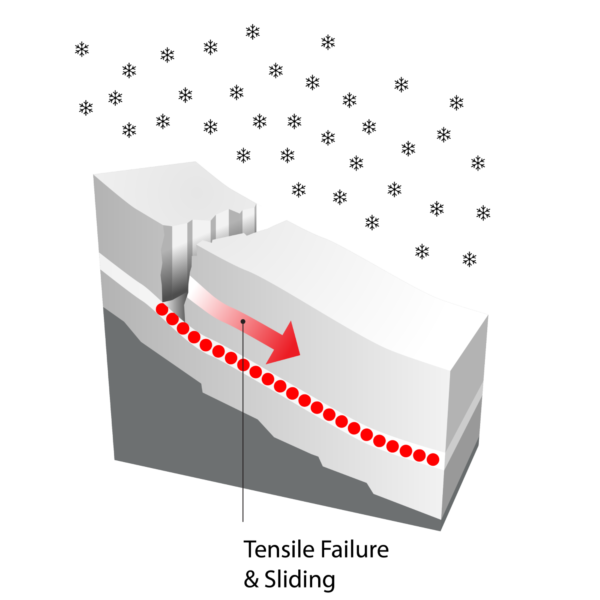
The mechanism works like this:
- The trigger upsets the critical balance.
- The weak layer fails, and a failure begins.
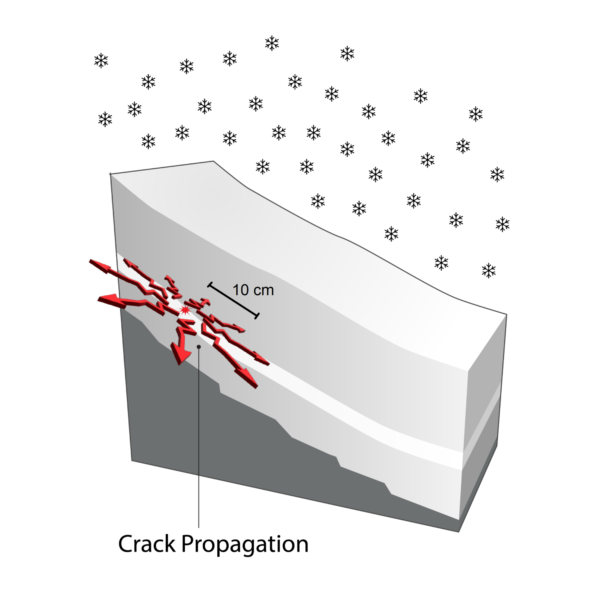
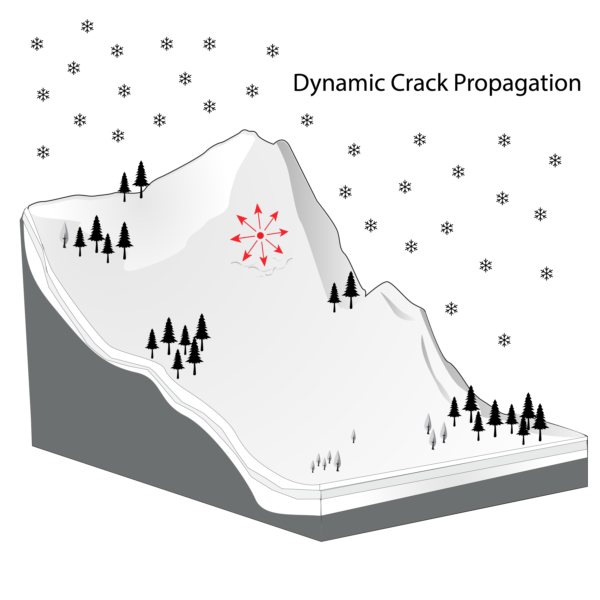
- The fracture propagates through the weak layer.
- The slab releases, resulting in a slab avalanche.
Take this with you:
Anyone who goes into the mountains, and especially anyone who travels through avalanche terrain where no mitigation control is carried out, is potentially at risk. That's why everyone who heads into the mountains needs at least a minimum of avalanche training, should carry rescue gear (beacon, shovel, and probe), check the avalanche forecast before heading out, and discuss where the best terrain will be for tomorrow.
In upcoming posts we'll cover avalanche problems, their relationship with terrain, and levels of instability. As you can see, it's all connected, and we'll keep working to tie these topics together. In the meantime, here's a video to go along with this post.
See you in the next one
Jeremias Palavecino | Fer Martinez
Team BC Cooperative