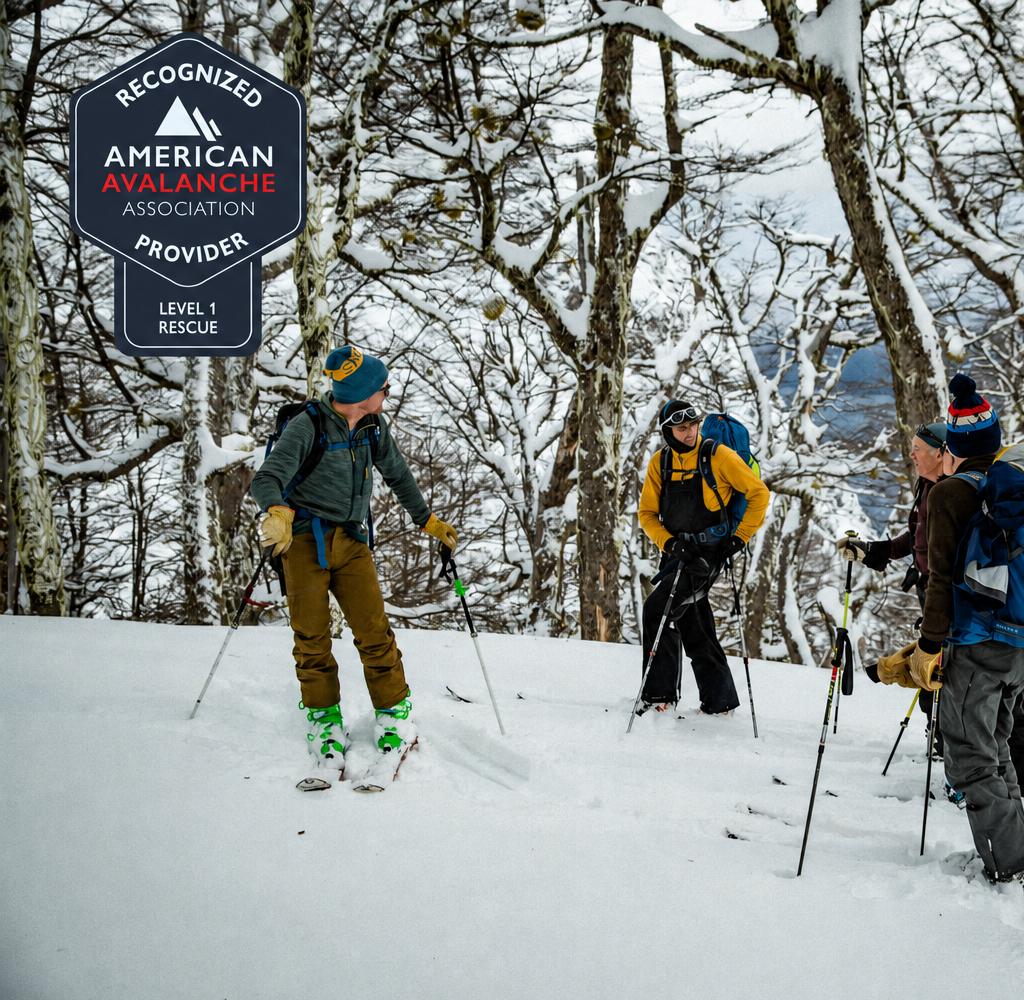
Welcome to the BCC Community! A new season of courses and training is here. Backcountry Cooperative is an A3 (American Avalanche Association) Recognized Provider, and this course integrates the official Recreational Level 1 (REC 1) + Avalanche Rescue curricula: upon completion you receive both internationally recognized certifications. Our idea, as always: to encourage you to practice this beautiful sport safely and skillfully, with practical tools you will use on every trip to the mountains.
The methodology is a flipped classroom: before each class you access the BCC virtual classroom (readings, videos, forms and short quizzes), the 3 in-person sessions are dedicated to discussion, exercises with real bulletins and terrain photos, and trip planning, and the 3 field days at Piltriquitrón (El Bolsón) — with 2 hut nights — are 100% hands-on: the first day is avalanche victim rescue, and the next two are terrain reading, snowpack, stability tests and decision-making, with more and more in your hands. All participants receive the BCC N1 Manual and the Field Book.
If you want to know the objectives and content, tap the itinerary tab.
This course is aimed at skiers and snowboarders with some backcountry experience who want to go further. An intermediate off-piste level and familiarity with touring equipment are expected. Meet partners for new adventures and learn about this complete and exciting activity.
Expected Outcomes of a BCC Level 1
Upon completion of the course, participants will be able to:
✅ Access the avalanche bulletin, interpret it and apply it to trip planning.
✅ Recognize avalanche terrain: critical slope angles, start zones, tracks, run-outs and terrain traps.
✅ Identify the current Avalanche Problems and link the day’s observations to the problem.
✅ Understand the fundamentals of avalanche formation and dynamics and recognize signs of instability.
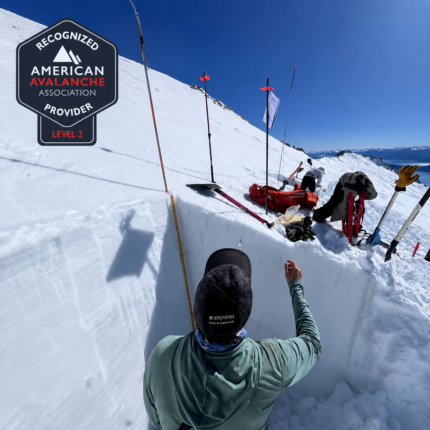
✅ Make snowpack observations and perform informal and formal tests (CT, ECT) and interpret them.
✅ Apply safe travel protocols: trailhead checks, spacing, safe zones and communication.
✅ Recognize human factors and heuristic traps, and use simple decision-making tools (ATES, go/no-go criteria).
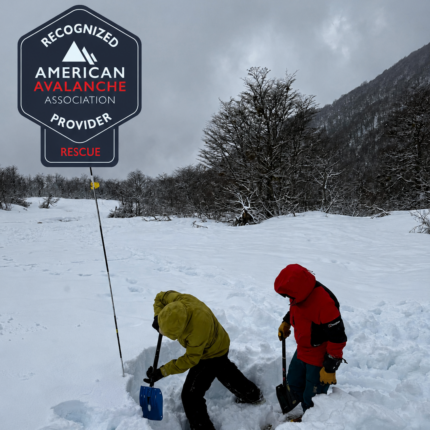
✅ Perform companion rescue: beacon search (single and double burial), probing and strategic shoveling.
✅ Plan and execute backcountry routes while managing group exposure.
✅ Understand the limits of their training, post-rescue medical priorities and how to activate emergency resources.
JULY 2026:
Classroom: July 20, 21 and 22, 6 to 9 pm.
Field: July 24, 25 and 26.
AUGUST 2026:
Classroom: August 3, 4 and 5, 6 to 9 pm.
Field: August 7, 8 and 9.
Course Details:
Classroom: In person at Colegio Qmark + BCC virtual classroom (study material, videos and quizzes).
Field: 3 days at Piltriquitrón (El Bolsón) with 2 mountain hut nights. Day 1: avalanche rescue. Days 2 and 3: terrain, snowpack and decisions.
Certification: REC 1 + Avalanche Rescue — official A3 (American Avalanche Association) curricula.
💰 Course Fee: 500 USD
Required equipment list:
Specific equipment:
– Touring skis with touring bindings and skins in good condition / Splitboard with bindings and skins in good condition.
– Ski touring boots / snowboard boots in good condition.
– Poles.
– Beacon with fresh batteries (>60%), SHOVEL AND PROBE (Mandatory)
– Helmet (Mandatory)
– Crampons
– Goggles
– Gloves (two pairs)
– Sunglasses / Sunscreen (+50)
Layered clothing:
– Thermal base layer (legs and torso)
– Fleece 100/200
– Waterproof shell jacket
– Down jacket
– Waterproof pants
– Ski socks
– Spare clothes (t-shirt, base layer, gloves, socks, underwear)
– Warm hat and sun cap
– Buff
Overnight and others:
– Sleeping bag (check hut requirements)
– Headlamp with batteries
– Camelbak
– Water bottle, 1 liter minimum
– Thermos
– Personal first-aid kit
– Cash (hut) and documents
– Notebook and pencil
– Camera
Rental equipment available:
– Skis/skins/bindings
– Splitboard
– Safety kit (Shovel, beacon and probe) ask for prices and availability
Location: Bariloche and El Bolsón (Cerro Piltriquitrón), Argentina
Duration: 3 in-person classes + virtual classroom + 3 field days with 2 hut nights.
Dates: July to October
Certification: REC 1 + Avalanche Rescue (A3 — American Avalanche Association).
Requirements: Ski black runs at a resort with confidence, good off-piste skills. Know your touring equipment. Good physical condition.
Guides and ratio: 5:1
Maximum: 10 people
No ski resort day pass required.
– AAGM/UIMLA Ski Mountaineering Guide and avalanche instructors.
– REC 1 + Avalanche Rescue certification (A3).
– Access to the BCC virtual classroom.
– BCC N1 Manual and study material.
– Field book.
– Satellite communication service.
– Personal accident insurance.
– Lodging and transfers in Bariloche and El Bolsón.
– Hut lodging and meals (paid directly at the hut).
– Safety equipment.
– Ski touring or splitboard equipment.
– Any item not specified in the program.
Leave us your question!
METHODOLOGY
Flipped classroom: virtual classroom (pre-course material)
+
3 in-person sessions
+
3 field days with 2 hut nights
Course with official A3 (American Avalanche Association) curricula: REC 1 + Avalanche Rescue.
EXPECTATIONS – COURSE OBJECTIVES
– Access the avalanche bulletin, interpret it and apply it to trip planning.
– Describe where, why and how avalanches form, including Avalanche Problems and their characteristics.
– Identify human factors and apply simple decision-making tools for avalanche terrain.
– Apply risk management tools: safety equipment, trailhead checks and group communication.
– Perform basic companion rescue: beacon search (single and double burial), probing and strategic shoveling.
– Make relevant snowpack and weather observations and link them to the current Avalanche Problems.
– Practice stability tests (CT, ECT) appropriate to the day’s Avalanche Problem and interpret them.
– Identify avalanche terrain in the field and choose terrain appropriate to the current forecast (ATES scale).
– Link group objectives to the terrain, managing exposure and applying safe travel practices.
– Understand the limits of the training, post-rescue medical priorities and emergency activation.
CONTENT
Pre-Course (Virtual Classroom)
– BCC virtual classroom: readings, videos, forms and short quizzes per unit.
– Human factors, terrain, Avalanche Problems, snowpack, bulletins, tests, planning and rescue — the theoretical base is studied before each class; the in-person sessions are for application.
Class 1 — Avalanche mechanics, Avalanche Problems, terrain and human factors
– Avalanche types, size classification, incident statistics and terminology.
– Avalanche mechanics: glide, turbulence, speed; dry vs. wet.
– The 9 Avalanche Problems: conditions, formation, characteristics. Work with the day’s bulletin.
– Terrain: critical angles, shapes, orientation to sun and wind, elevation, start zones, tracks and run-outs.
– Critical terrain: terrain traps, convexities, trigger points. Photo-based identification exercise with local terrain. ATES scale.
– Human factors: mental shortcuts and heuristic traps, mindset. Local case study discussion.
Class 2 — Snowpack, data, critical thresholds and bulletins
– Mountain snowpack development: weather events and the formation of strong and weak layers. Metamorphism. Snow climates by region.
– Data classification and critical thresholds: which observations matter, red flags.
– Public Avalanche Bulletin: how to access it, danger scale, terrain rose, interpretation and limitations. Exercise with a real bulletin.
– Snowpack observations and tests: use of inclinometer, compass, probe, saw, shovel and thermometer. Quick profile, layers and hardness. Informal and formal tests (CT and ECT), fracture character. Which test for which problem.
Class 3 — Trip planning and rescue
– Group itinerary planning workshop: maps and technology, decision points, go/no-go criteria, plan B and emergency plan. Field book and forms.
– Applied human factors: group pressure scenarios and decision tools. Group communication.
– Companion rescue: survival curves, full rescue sequence, beacon (search phases, live demo), probing, strategic shoveling, common errors.
– Role of first aid and emergency response in real avalanche rescues.
– Field days briefing: logistics, equipment and gear check.
Field — Day 1: Avalanche victim rescue
– Ascent technique on the approach to the hut: turns and kick turns.
– Beacon check and search phases: signal, coarse and fine.
– Individual practice on search courts: simple burials with one and two victims.
– Probing and strategic shoveling: conveyor-belt method.
– Full incident response scenario: roles, leadership and communication.
Field — Days 2 and 3: Avalanche terrain management
– Start-of-day check (beacon / equipment) and plan re-check: conditions, weather and terrain.
– Route selection, skin track setting and safe zones.
– Observations while moving: critical thresholds and red flags. Interpretation according to the current problem.
– Observation pits: snowpack structure, layers and hardness, CT and ECT tests with field book recording.
– Group management in terrain: communication, spacing, open / closed terrain (ATES).
– Final student-led day: route decisions, descent plan and exposure management.
– End-of-day review: observations and reflections with the group. Course close.
FIELD: Piltriquitrón Hut (El Bolsón)
The 3 field days take place in the Cerro Piltriquitrón area, with 2 nights at the mountain hut. We choose a rarely visited area with simple logistics, so students can make the most of what they have learned.
On the first day we climb to the hut learning ascent technique (turns and kick turns), and in the afternoon we dedicate ourselves fully to avalanche victim rescue near the hut. On days 2 and 3 we apply all the course knowledge: terrain reading, snowpack observations and tests, and decision-making — with the last day led by the students themselves.
Access is easy: the hut is about one hour from La Plataforma. Practice takes place nearby and up to 3–4 hours away. Participants must have basic ski mountaineering experience: on the first day you climb with overnight gear in your pack (approx. 8 kg), and on the following days with a day pack.
Days of approximately 8-10 hours are expected.