BCC Rescue | Bariloche

1 classroom session + 1 field day
  • WhatsApp Image 2026-07-15 at 12.16.00 PM (3)

Welcome to the BCC Community! Backcountry Cooperative is an A3 (American Avalanche Association) Recognized Course Provider, and this course follows the official Avalanche Rescue curriculum. Upon successful completion, you will receive the BCC Rescue certificate, internationally recognized. Companion rescue is the single most effective intervention in an avalanche accident—the first 15 minutes determine the outcome, and organized rescue almost always arrives later. This course prepares you for that critical moment.
The course is delivered in an intensive format: one 3-hour in-person classroom session covering avalanche rescue principles, transceiver use in depth, probing, strategic shoveling, and the complete rescue sequence, followed by one full field day (8 hours, at Catedral or Cerro López) that is 100% hands-on: timed transceiver drills, single- and multiple-burial search scenarios, team shoveling, and realistic rescue scenarios with rotating leadership. 73% of the course takes place in the field—well above A3 minimum requirements.
To learn more about the course objectives and content, click on the itinerary tab.
This course is designed for backcountry skiers, splitboarders, snowshoers, and mountaineers traveling in winter terrain—as well as aspiring mountain professionals and rescue volunteers. There are no formal avalanche prerequisites: it is the ideal course to get started, to accompany someone who has already taken avalanche training, or to refresh rescue skills that fade quickly over time. It is also the required companion course for REC 1 graduates whose avalanche training did not include a certified rescue module.

Expected Learning Outcomes – BCC Rescue

By the end of the course, participants will be able to:

✅ Understand priorities and actions during an avalanche incident—as both a victim and a rescuer.
✅ Assess scene safety before beginning a search: last seen point, number of victims, and emergency activation.
✅ Perform a complete avalanche transceiver search—signal search, coarse search, fine search, and pinpoint search—for single and multiple burials within target times.
✅ Probe accurately and apply strategic shoveling (conveyor belt method) for efficient excavation.
✅ Organize a search without transceivers using probe lines for victims without rescue equipment.
✅ Lead and communicate effectively during a rescue: assigning roles, coordinating the team, and managing the group.
✅ Understand the expected medical issues after excavating a buried victim and recognize the need for additional medical training.
✅ Know how to activate emergency resources and what to expect from an organized rescue (EMS, helicopter).

UPCOMING DATES:

Contact us. Multiple editions each season, from July through October.

Course Details:

Classroom: One 3-hour in-person session at Qmark School + BCC online classroom (study materials and course notes).
Field Day: One full day (8 hours) at Catedral or Cerro López, depending on conditions. Meeting at 9:00 AM, finishing around 4:00 PM. No overnight stay required.
Certification: BCC Rescue — official Avalanche Rescue curriculum by A3 (American Avalanche Association).

💰 Course Fee: USD 150

Required Equipment:

Technical Equipment:

– Backcountry skis with touring bindings and climbing skins in good condition / Splitboard with bindings and skins in good condition (you may also participate with snowshoes).
– Alpine touring ski boots / Snowboard boots in good condition.
– Ski poles.
– Avalanche transceiver with fresh batteries (battery level above 60%), SHOVEL AND PROBE (Mandatory).
– Helmet (recommended).
– Goggles.
– Gloves (two pairs—you will be doing a lot of shoveling).
– Sunglasses / Sunscreen (SPF 50+).

Layered Clothing:

– Thermal base layer (legs and upper body).
– Fleece jacket (100/200 weight).
– Waterproof shell jacket.
– Down insulated jacket.
– Waterproof pants.
– Ski socks.
– Warm hat and sun cap.
– Buff / Neck gaiter.

Other:
– Camelbak or water bottle (minimum 1 liter).
– Thermos and lunch for the day.
– Personal first aid kit.
– ID and cash.
– Notebook and pencil.

Rental equipment is available:

– Touring skis / skins / bindings.
– Splitboard.
– Avalanche safety kit (transceiver, shovel, and probe). Contact us for pricing and availability.

Location: Bariloche, Argentina (Catedral or Cerro López—selected according to conditions and group).

Duration: One 3-hour in-person class + online classroom + one full field day (8 hours).
Dates: July through October. Contact us for upcoming editions.
Certification: BCC Rescue — Avalanche Rescue (A3 — American Avalanche Association).
Prerequisites: No formal avalanche training required. Participants may attend using touring skis, a splitboard, or snowshoes.
Guide-to-Participant Ratio: 6:1.
Minimum group size: 6 participants.

– AAGM/UIMLA Mountain Ski Guide and avalanche instructors.
– BCC Rescue certificate recognized by A3.
– Access to the BCC online classroom.
– Personal accident insurance.

– Ski resort day pass (if the field session is held at Catedral).
– Accommodation and transportation in Bariloche.
– Meals.
– Avalanche safety equipment.
– Touring ski or splitboard equipment.
– Any item not specifically listed in the program.


Contact Us!

METHODOLOGY
Flipped classroom: BCC online classroom (pre-course materials)
+
1 in-person classroom session (3 hours)
+
1 full field day (8 hours)
Course following the official A3 (American Avalanche Association) Avalanche Rescue curriculum. 73% of the course takes place in the field—well above A3 minimum requirements.

EXPECTED LEARNING OUTCOMES
– Understand priorities and actions during an avalanche incident—as both a victim and a rescuer.
– Assess scene safety before beginning a search: last seen point, number of victims, and emergency activation.
– Perform a complete avalanche transceiver search—signal search, coarse search, fine search, and pinpoint search—for single and multiple burials within target times.
– Probe accurately using the correct probing pattern, maintaining perpendicular technique and confirming victim contact.
– Apply strategic shoveling (conveyor belt method): select the correct excavation starting point based on slope angle, rotate rescuers efficiently, and perform careful excavation near the victim.
– Organize a search without avalanche transceivers using systematic probe lines.
– Lead and communicate effectively during a rescue by assigning roles, coordinating the team, and managing the group.
– Understand the expected medical issues following excavation (asphyxia, trauma, hypothermia) and the priorities for patient care.
– Know how to activate emergency resources and what to expect from an organized rescue (EMS, helicopter).
– Develop the habit of performing transceiver checks and practicing companion rescue on a regular basis.

COURSE CONTENT

Pre-Course (Online Classroom)

– BCC online classroom: rescue notes, instructional videos, and avalanche safety equipment resources.
– Know your equipment: avalanche transceiver, shovel, probe, and complementary safety devices (airbag, RECCO, helmet).

In-Person Class — Rescue Principles, Equipment, and Techniques (3 hours)

– Rescue principles: survival curves and burial times—why the first 15 minutes determine the outcome. Avalanche burial statistics.
– Rescuer safety and scene assessment. Victim response: what to do if you are caught in an avalanche.
– Avalanche transceivers in depth: multi-antenna technology, 457 kHz standard, transmit versus search mode, search phases (signal, coarse, fine), common mistakes, multiple burial management, and marking function.
– Probing: probing pattern, perpendicular technique, and confirmation strike. Strategic shoveling: conveyor belt method, rescuer rotations, and deep burial excavation.
– Complete companion rescue sequence: scene safety, last seen point, role assignment, emergency activation, transceiver search, probing, and shoveling.
– Searches without avalanche transceivers: organized probe-line techniques.
– Medical considerations after excavation and external rescue resources: EMS, Incident Command System (ICS), and basic helicopter rescue operations.
– Field day briefing: logistics, equipment, and gear check.

Field Day — Full Day (8 hours)

– Morning transceiver check and ascent techniques during the approach: kick turns and uphill travel.
– Demonstrations of search phases, fine search, probing patterns, and multiple burial marking.
– Individual practice on 50 × 50 m search areas: single and multiple burial scenarios with timed drills and individual feedback.
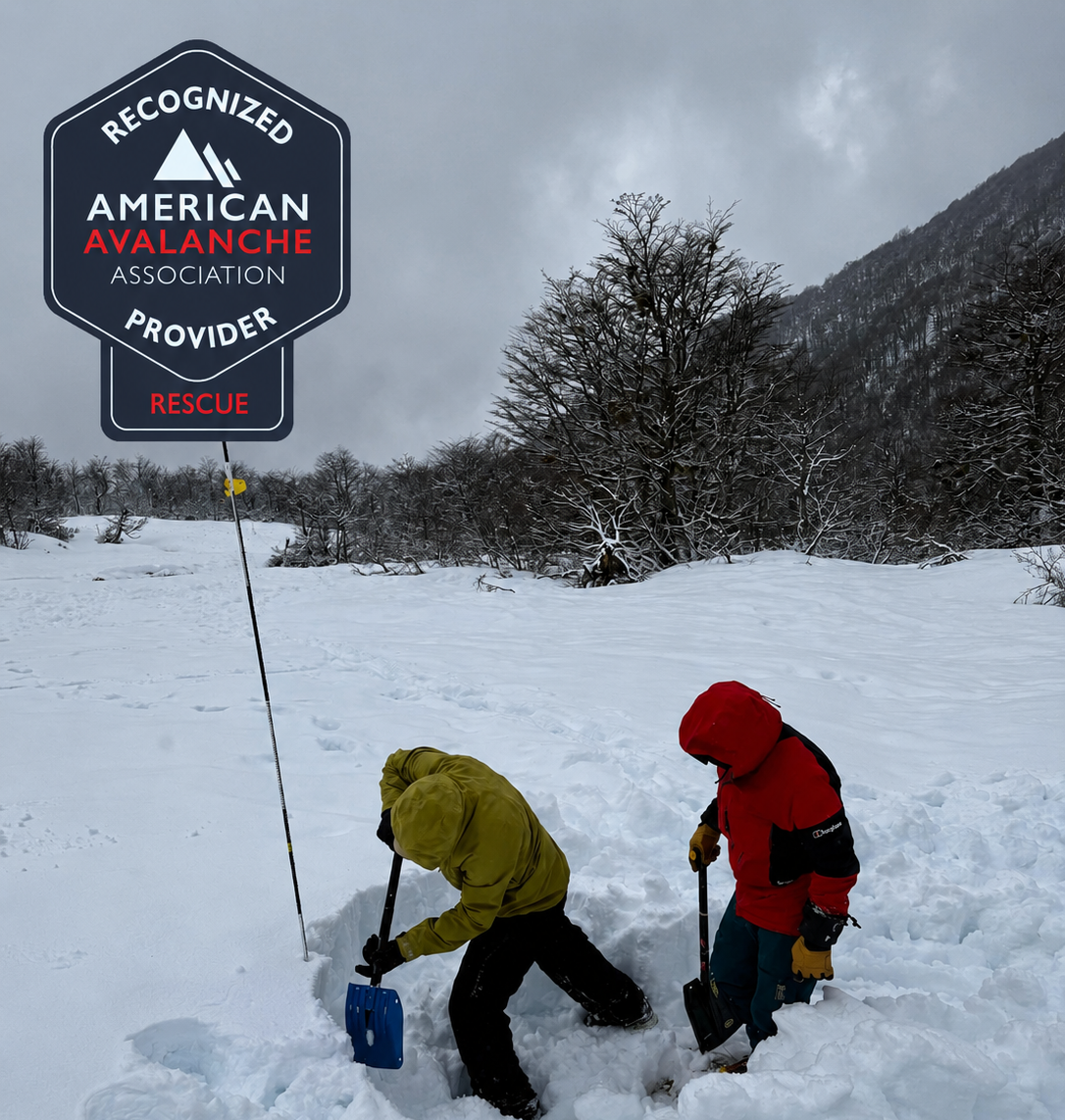
– Systematic probing and team strategic shoveling: conveyor belt method, rescuer rotations, and airway access.
– Organized probe-line searches without avalanche transceivers.
– Full rescue scenarios: scene safety, role assignments, rotating leadership, team communication, and structured debrief after every exercise.
– Course wrap-up: limitations of companion rescue, importance of ongoing practice, and the pathway toward comprehensive avalanche education (BCC Level 1).

FIELD LOCATION: Catedral or Cerro López

The field day takes place at either Catedral or Cerro López, with the final location selected according to snow conditions and the group. We choose a safe, open area outside the ski runs where realistic search areas and rescue scenarios can be set up.

The day runs from approximately 9:00 AM to 4:00 PM. The approach to the practice area is used to review uphill travel techniques (kick turns and transitions), while the remainder of the day is dedicated to intensive rescue practice. Every participant completes multiple search scenarios, participates in team excavations, and practices realistic rescue situations with rotating leadership roles.

This is a single-day course with no overnight stay. Participants carry only a light day pack containing water, lunch, extra clothing, and their avalanche safety kit (transceiver, shovel, and probe). Participants should be comfortable skiing or riding easy backcountry terrain and have the physical fitness required for an 8-hour day of intensive practical exercises—you will spend a lot of time shoveling.

Please note that the practice location may change depending on snow and weather conditions. If the field session takes place at Catedral Ski Resort, a valid day lift ticket is required.

Price:$150.00

Book the tour

 Number ticket  × $150.00
Total = $150.00